


Article: Karavaki: Why Greeks Decorate a Boat at Christmas

Karavaki: Why Greeks Decorate a Boat at Christmas
When most of the world thinks of Christmas, they picture a fir tree dressed in lights. But walk through a Greek island village in December and you may find something else glowing by the door: a little wooden boat, its sails strung with lights, its bow pointing into the home. This is the karavaki — Greek for "little boat" — and it is one of the most beautiful Christmas traditions Greece has.
A country that lives by the sea
For Greece, the sea has never been scenery. It has been livelihood, road and risk. For generations, island and coastal families watched their fathers, sons and husbands sail away for months at a time. When the boats finally appeared on the horizon in winter, the whole village breathed out.
Decorating a little boat at Christmas grew from that feeling — a way of honouring the sailors, of celebrating the safe journey home, and of looking forward to the year ahead. Many also see in it a symbol of sailing towards the new life that Christmas brings.

Saint Nicholas, protector of sailors
One of the best-loved explanations links the karavaki to Agios Nikolaos (Saint Nicholas), patron saint of sailors. His feast day falls on 6 December, the day many Greek households traditionally begin decorating for Christmas. Dressing a boat in his honour felt only natural.
Little customs with big meaning
The karavaki was traditionally placed near the front door or the fireplace, with its bow pointing inwards — a sign of a successful journey home, and of good fortune sailing into the house. Some families placed coins or small gold objects inside the boat, as a wish for a prosperous year.
When the tree arrived
The Christmas tree came to Greece in the 19th century — the first is said to have been decorated by King Otto of Bavaria in 1833. Little by little the tree took centre stage, and the karavaki drifted into the background.
But traditions that carry this much meaning have a way of coming home. In 1999, Thessaloniki lit a large Christmas boat in Aristotelous Square, and Athens followed in Syntagma Square. Today you will often see the two side by side in Greek squares and homes: the tree, and the boat.
Bringing the karavaki into your home
You don't need to choose between tree and boat — Greek families today happily have both. A few simple ideas:
- Start on 6 December, Saint Nicholas' Day, the traditional beginning of the season.
- Point the bow inwards, towards the room, to welcome good fortune in.
- Keep it simple: warm white lights, a touch of blue and white, perhaps a small olive branch.
- Tuck a coin inside as a wish for the year ahead.
- Tell the story to the children (and the guests) — that's how traditions survive.
A piece of Greek Christmas, wherever you are
For Greeks living far from the islands — here in Australia and around the world — the karavaki is a small, glowing reminder of where we come from. It's exactly the kind of meaning we look for in every piece at Thalassea: objects that carry a story, made by hand by independent Greek artisans.
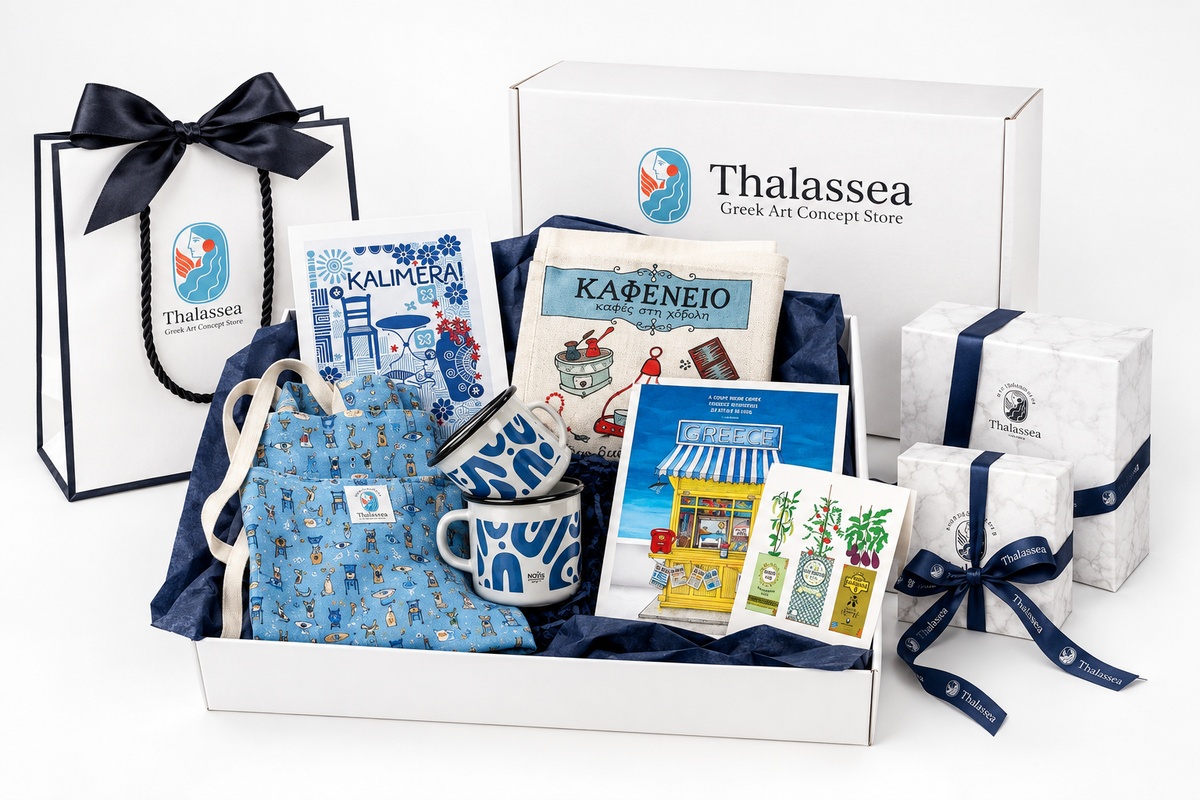
This Christmas, explore our Karavaki Christmas Gift Box and our Greek Gift Boxes, curated by hand and sent gift-wrapped from Melbourne. Order by 21 December for Christmas delivery in Australia.
Καλές Γιορτές Με Υγεία — and may your boats always come home.
Curated with Culture, Crafted with Care.